The Power of Intuition and the Creative Process With Iva Golubovic

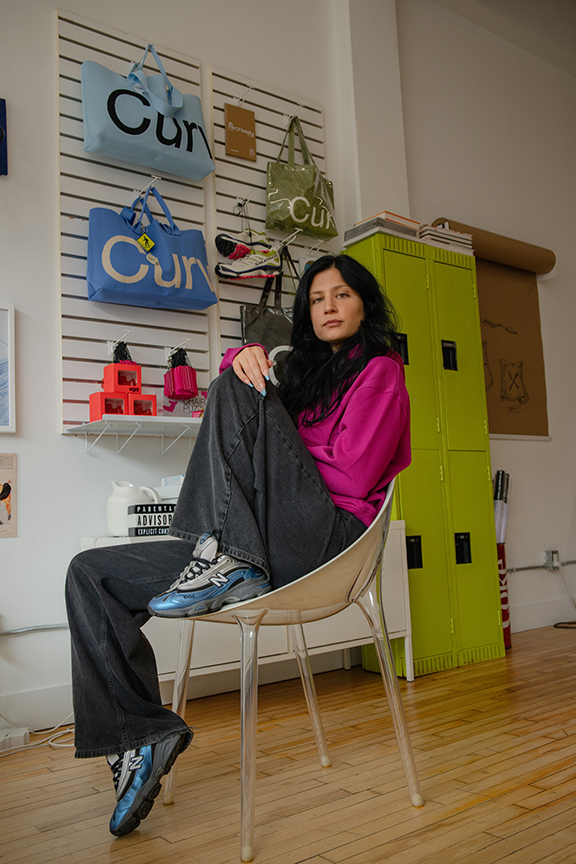
Iva Golubovic, a multidisciplinary creative, sits across from me in her Toronto studio, light spilling across a floor strewn with plants, art books and camera gear. The room feels expressive and alive yet disciplined, a true testament to her creative practice. She’s at ease as camera shutters softly go off around us, and we’re invited to uncover lessons from her past.
Lush greenery, metal fixtures and pristine white gallery walls immerse you in works from the minds of Golubovic and her long-time collaborator, Sean Brown. The duo’s professional relationship spans nearly a decade. First, they collaborated on music video sets in the 2010s and later launched a homeware brand, Curves, in the summer of 2018. In that time, it’s no surprise that they’ve amassed an immense amount of work.
“I was cleaning up my computer like literally yesterday because my disk is full,” she tells me. Every early project or failed attempt has played a role in shaping Golubovic’s creative approach. As she arranges her archives, she does so carefully with a touch of grace and curiosity, knowing that they will inform her future work.
She came across some old pitch decks and previous work with clients that stirred something within her. “[Sean and I] were both saying, like it's so nice to look back at that. And those things we've been proud of.” There’s an unspoken commitment to focusing on your future as a creative, always two steps ahead of what’s currently in front of you, trying to chase that new high. The act of looking back has become an imperative reflection, a way to consider new directions and to step outside of the growing pressure to challenge your ethos in this industry.
There’s a generosity in the way Golubovic speaks about her past work. She examines the wins, challenges, and pivotal moments — even the areas that didn’t quite work — and uses them to inform her creative process. Reflection fuels her evolution. Each new endeavour is held with the same care as those that came before; the past, even when imperfect, still offers knowledge that she’s cautious not to discard. This practice began at Western University in London, Ontario, where Golubovic studied film theory after steering away from a business degree.
This period of her life was a catalyst for her creative future. In the quiet lecture halls of the London campus, Golubovic learned the value that visual media has in pushing discussion. “That has stuck to me so, so much, and I carry it with me, I think, even in non-creative things that I do. I feel the need to process something that's happening, voice how I'm feeling about it … a lot of the time you're going to get pushed back, but I think the people that push back the right way end up being the people you want to work with.”

This openness to dialogue and commentary has influenced both her professional process and her own definition of success. The ability to exchange ideas honestly and be challenged by collaborators who push back the right way has become its own kind of achievement. Golubovic’s ideas stay in motion — a quiet yet consistent thread that runs through everything she has accomplished. There’s trust in movement, acknowledging that there’s always something to learn from and a suspicion of stasis.
“There’s this thing where I feel like I’m plateauing, I start to get really restless,” she told me. “I want to learn more.” This is no clearer than in the various skills Golubovi keeps in her toolbox, including experience in marketing and promotion with the Remix Project, producing The Office Movers (2024), and creating music videos for artists like Daniel Caesar and Jesse Reyez, as well as co-founding and operating Sunflower Studios. It’s clear to all that Golubovic thrives when she trusts her intuition and stays in motion. “If I'm doing different things, then I feel like I can learn and bring new skill sets to something … I need to be thinking, what can I be doing from now until I don't know, I’ll probably never retire, but you know, whatever that time frame is.”
This restlessness is less about ticking off milestones and more about a higher journey centred on understanding oneself and one's own needs. It’s become about giving herself room to keep evolving rather than staying in the comfort and safety of what’s familiar. Instead of being clouded by visions of glamorized achievements, we look at an honest pathway to success. Golubovic’s instinct to remain adaptable and wear multiple hats is part of what has enabled her to continue growing in a city where longevity often requires compromise.

Being fluid, however, doesn’t mean operating without structure; it means creating a framework where adaptation is possible and sometimes necessary. For Golubovic, that flexibility has often meant the difference between a project's survival and its stall. In the absence of institutional support for emerging or independent artists, being multidisciplinary is a matter of survival.
And in Toronto, that survival is rarely guaranteed.
It's no secret that this city is frequently portrayed as a creative hub, but behind the glossy panels and campaigns lies an industry that has been hollowed out by underfunding, gatekeeping, and an increasingly narrow pipeline of opportunities. Golubovic’s entrance point — working on music videos funded by grants — is no longer as accessible today. While public funding still exists, the application process is often opaque and skewed toward creatives who already have recognition, connections, or fluency in “grant-speak”.
“I remember processing that,” Golubovic reflects. “Seeing my friends who have ideas and projects and things, and myself applying for grants and seeing how little the grant money ends up being, and what you have to do to actually actualize the project that you’ve got your grant money for.” She names what many artists have felt but don’t always say aloud: that even the act of applying for support means submitting your vision to gatekeepers who often value predictability over experimentation to safeguard a legacy. “We are generally a conservative country,” she continues. “Like [they’ll say] you can make it, but it has to have this or that … I just don’t know that anyone has the right to decide what Canadian culture should look like. We should all just do that ourselves.”
And so she has.

Golubovic notes that the current cultural landscape is defined by hyper-individuality. Everyone is drawing from similar references, histories and moods to determine their own practice, which can lead to a superficial product. Understanding the relationship between space and culture is essential to the creative process when creating art, although grasping it may seem daunting at first. Through spending years in education, learning and understanding the work that came before her, Golubovic has been able to authentically create without falling into the trap of paying homage time and time again.
She’s clear about the value of building something new to stay true to her vision rather than borrowing from others, and honest about the direction she’d like a project to take. Reaching this point of self-actualization hasn’t come easy. “It’s something that I work on constantly,” she says. “I find a lot of grounding in my spirituality … and I feel like as long as I’m listening to myself and my intuition, that’s how I get to a point where I know that I like this and I can be my own barometer.” By centring her focus on her craft rather than the work of those around her, she’s been able to operate with purpose.
In a time of rapid trend cycles and endless copycats, standing out requires intention. “Social media has given [us] so much access to different aesthetic references … from around the world,” she says. “I think if you don’t do the work to understand why that aesthetic was that way at the time, what you’re doing is applying shallow references.” This understanding defines Curves: design that is more than referential and sparks new conversations within the zeitgeist. So, where is the conversation headed?

“I'm curious to know what somebody in 20 years is going to think the aesthetic of today is,” she says, gazing out the window next to us. “It almost feels like there are so many people trying to emulate something else, whereas I'm like, what happened! Can we even be present enough to create an aesthetic of today?”
Rather than chasing nostalgia, Golubovic is more interested in creating work that’s honest to the present moment — even if that present is fragmented, contradictory or in flux. She’s in constant motion, challenging the rigid structure we’ve been sold our whole lives. Looking at how far that mindset has taken her, she must be doing something right.
EDITOR-IN-CHIEF Maddison Hoyt
CREATIVE DIRECTION Stecy Helena Franck
ART DIRECTION Hannah Clifton, Sanya Sharma
COVER STORY Lucy Kebirungi
PHOTOGRAPHER Rowena Gao
MOVEMENT DIRECTOR Tristan Campbell
STYLING Ava Quimby
MAKEUP Marsekei
HAIR Zachat Oluafah
DESIGNERS FEATURED
Curves At Home
Sagradesa
Emily Kitching
Chime Creations


Comments